Doodle Houses: A Hand-Drawn Seamless Pattern for Design Flexibility
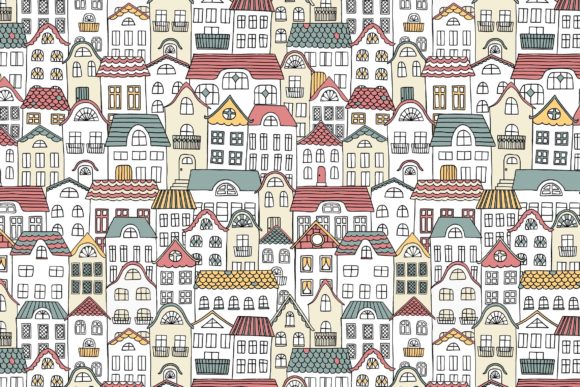
Doodle Houses refers to a specific, hand-drawn seamless pattern featuring stylised, whimsical houses arranged in an organic, repeating layout. Unlike generative AI patterns or photorealistic architectural illustrations, this design prioritises warmth, texture, and intentional imperfection — the kind you’d expect from ink on paper. It’s not just decorative; it’s built for adaptability across both digital and print applications, with three distinct file formats included: a high-resolution JPG (5000 × 5000 px), a scalable SVG vector, and an EPS vector. A black-and-white version is also provided, expanding its utility for engraving, embroidery, or monochrome printing.
What Sets Doodle Houses Apart from Other Pattern Types
Most seamless patterns fall into one of two broad categories: geometric precision or photographic realism. Doodle Houses occupies a middle ground — expressive but structured, illustrative but repeatable. Its hand-drawn quality introduces subtle variations in line weight, window shape, roof angle, and chimney placement. These aren’t inconsistencies; they’re intentional cues that signal human authorship and visual rhythm. That makes it distinct from algorithmically generated “doodle-style” patterns, which often rely on repetition of identical elements and lack the organic flow found here.
Unlike clipart libraries or stock vector packs where houses appear as isolated icons, Doodle Houses is designed as a true seamless tile. That means it repeats without visible seams or alignment breaks — a practical advantage when covering large surfaces like wall murals, fabric swatches, or website backgrounds. The spacing between houses is generous enough to avoid visual crowding, yet tight enough to maintain cohesion at small scales, such as on notebook covers or social media banners.
File Format Tradeoffs: When to Use JPG, SVG, or EPS
The inclusion of multiple formats gives users real flexibility — but each has clear strengths and appropriate use cases.
- JPG (5000 × 5000 px): Best for immediate use in raster-based workflows — think web design, social media graphics, or digital presentations. Its high resolution ensures clarity even when scaled down for thumbnails or up for large-format prints (within reasonable limits). However, it cannot be recoloured non-destructively and loses fidelity if enlarged beyond its native dimensions.
- SVG: Ideal for web developers and designers using modern CSS or responsive layouts. SVGs scale infinitely without pixelation and support CSS-based colour changes — useful for dynamic themes or accessibility-driven contrast adjustments. They integrate smoothly into HTML, Figma, or Adobe XD prototypes. Limitations include limited support for complex gradients or raster effects in some older browsers.
- EPS: Preferred by professional print providers and users of legacy Adobe Creative Suite versions. EPS remains widely accepted for offset printing, signage, and packaging workflows where precise spot colour control or CMYK separation is required. While less web-friendly than SVG, it offers broader compatibility with prepress systems.
The black-and-white version adds another layer of versatility — especially for laser cutting, screen printing, or educational materials where simplicity and contrast matter more than colour variation.
Comparing Doodle Houses to Broader Design Approaches
When evaluating illustration styles for branding, product design, or environmental graphics, Doodle Houses fits most naturally within the “friendly, approachable, and human-centred” category. It contrasts with minimalist line art (which tends toward abstraction and restraint) and with detailed architectural renderings (which emphasise realism and technical accuracy). It also differs from collage-based or mixed-media patterns, which often introduce texture overlays or photographic elements — something Doodle Houses avoids in favour of clean, consistent linework.
This distinction matters in practice. For example, a children’s book publisher might choose Doodle Houses for endpapers because its warmth supports storytelling without overwhelming young readers. A boutique stationery brand could use the SVG version to generate custom-coloured wrapping paper for seasonal campaigns — changing palette per collection without redrawing. Meanwhile, a university housing office might adapt the black-and-white variant for orientation brochures, pairing it with accessible typography and high-contrast text.
Realistic Use Cases and Practical Limits
Doodle Houses works well where tone and recognisability matter more than strict realism. It’s been applied successfully to:
- Custom-printed fabric for nursery decor or café aprons
- Branded merchandise like tote bags, mugs, and stickers
- Web page backgrounds and section dividers in education or community-focused sites
- Printed materials for co-working spaces or creative studios seeking a relaxed, collaborative aesthetic
That said, it isn’t universally suitable. Projects requiring photorealism — such as architectural portfolios or property development visuals — would benefit more from 3D renders or curated photography. Similarly, corporate identity systems aiming for austerity, authority, or global neutrality may find the playful tone too informal. Doodle Houses doesn’t include labels, street names, or regional architectural markers, so it’s not ideal for location-specific wayfinding or civic projects needing geographic authenticity.
Colour Customisation: A Key Decision Factor
The vector versions (SVG and EPS) allow full recolouring — a significant advantage over static JPGs. Users can adjust individual house elements, roofs, windows, or background tones using standard vector editors. This means one purchase supports multiple brand palettes, seasonal updates, or A/B testing for marketing assets. But it does require basic familiarity with tools like Adobe Illustrator, Affinity Designer, or Inkscape. Those unfamiliar with vector editing may find the JPG more immediately usable — albeit with less long-term flexibility.
It’s worth noting that the original colour scheme leans into soft, muted tones — sage greens, dusty pinks, warm greys — but the vectors don’t restrict users to those choices. You can push the palette toward bold primaries for a toy brand or desaturate it entirely for a vintage-inspired look. The black-and-white file further extends that range, enabling duotone treatments or foil-stamped applications.
When Doodle Houses Is the Right Choice — and When It Isn’t
Doodle Houses is most effective when your goal is to convey approachability, creativity, or groundedness — especially in contexts where people interact with space, home, or community. It suits small businesses, educators, independent publishers, and designers who value craft over automation.
It’s less suited for situations demanding:
- Technical specificity: If you need accurate roof pitches, period-appropriate details, or zoning-compliant layouts, this pattern won’t serve that function.
- Highly branded iconography: Doodle Houses uses generic house forms — not custom silhouettes tied to a logo or mascot. Integrating it into an existing brand system requires thoughtful pairing, not plug-and-play alignment.
- Dynamic interactivity: While SVG enables colour shifts, it doesn’t support animation or user-triggered states out of the box. Adding motion would require additional development work.
In short: choose Doodle Houses when you want a cohesive, scalable, and emotionally resonant background element — not a standalone hero image or functional diagram.
Making an Informed Choice Among Pattern Options
Evaluating Doodle Houses alongside alternatives comes down to purpose, audience, and workflow. Ask yourself:
- Does the tone match how I want people to feel when engaging with this material?
- Do I need to change colours frequently — and do I have the tools or support to do so efficiently?
- Will this be used primarily on screen, in print, or across both — and at what scale?
- Is consistency across formats (e.g., matching website and business cards) a priority?
If the answers point toward warmth, adaptability, and hand-crafted authenticity — and you’re comfortable working with vectors or high-res rasters — Doodle Houses offers a balanced, production-ready solution. If your needs skew toward realism, rigidity, or automation, exploring architectural photo libraries, parametric design tools, or custom illustration commissions may be more appropriate next steps.